Cloudflare's 1.1.1.1 Now Has a Slovenian PoP
Cloudflare's 1.1.1.1 is now served from Slovenia — fast, private, optionally filtered DNS with zero latency trade-off.
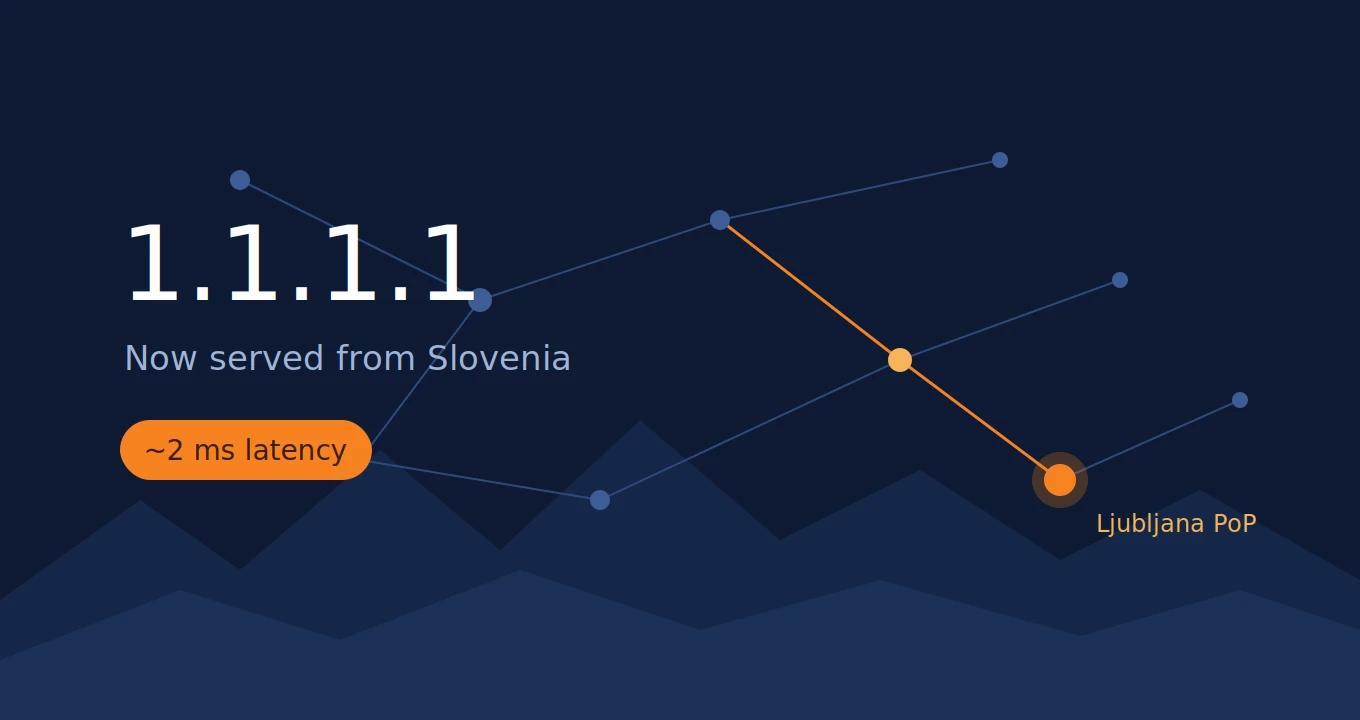
Cloudflare's 1.1.1.1 DNS Is Now Served Locally in Slovenia — Here's Why That Matters
Cloudflare, the world's largest CDN provider, has quietly deployed servers in Slovenia that answer DNS queries for its public resolver, 1.1.1.1. Until now, queries from Slovenian networks were typically routed to points of presence in Vienna, Zagreb, or Milan. With a local node, response times drop to just a few milliseconds — effectively as fast as your ISP's own resolver, and often faster.
If you've been hesitant to switch to a public DNS resolver because of the latency penalty, that argument just evaporated for anyone browsing from Slovenia.
A quick refresher: what 1.1.1.1 actually is
DNS is the phone book of the internet — every time you open a website, your device first asks a DNS resolver to translate the domain name into an IP address. By default, that resolver belongs to your ISP.
Cloudflare's 1.1.1.1 is a free, privacy-focused alternative. It's consistently among the fastest public resolvers globally, and Cloudflare commits to not selling query data or using it for ad targeting.
Beyond the plain resolver, Cloudflare offers two filtered variants worth knowing about:
- 1.1.1.2 — blocks known malicious domains (phishing, malware distribution, and similar threats) at the DNS level
- 1.1.1.3 — everything 1.1.1.2 does, plus filtering of adult content, making it a simple network-wide family filter you can set on a home router in about a minute
Why local presence changes the math
DNS latency compounds. A single page load can trigger dozens of DNS lookups — the page itself, its CDN assets, analytics scripts, fonts, embedded widgets. Shaving even 10–15 ms off each uncached lookup adds up to noticeably snappier browsing, especially on first visits to a site.
With Cloudflare now answering from within Slovenia, traceroutes from local ISPs show responses in the 1–3 ms range on fiber connections. That's the kind of number you previously only got from your ISP's own resolver sitting a few hops away.
Privacy: what switching your DNS does — and doesn't — do
This is where a lot of people overestimate the benefit, so let's be precise.
If you use 1.1.1.1 over DNS over HTTPS (DoH) or DNS over TLS (DoT), your DNS queries are encrypted. Your ISP can no longer see, log, or tamper with your lookups, which neutralizes DNS hijacking, spoofing, and DNS-level traffic inspection.
But your browsing isn't invisible. When your browser opens an HTTPS connection, it still sends the hostname in plaintext inside the TLS ClientHello — the SNI field. Your ISP can't see your DNS queries anymore, but it can still see which domains you're connecting to.
The missing piece is ECH (Encrypted Client Hello), the successor to ESNI, which encrypts the entire ClientHello including the SNI. Cloudflare supports it on their edge, and recent Firefox versions can use it, but adoption across the wider web is still ramping up. Once ECH becomes commonplace, DoH + ECH together will genuinely hide your browsing destinations from network-level observers. Until then, if you need full traffic privacy, that's still VPN or Tor territory — each with its own trust trade-offs.
How to switch (60 seconds)
On your router (applies to every device on the network): set primary DNS to 1.1.1.1 and secondary to 1.0.0.1 — or 1.1.1.3 / 1.0.0.3 if you want the family filter.
In your browser (with encryption): enable DoH in settings — Firefox, Chrome, and Edge all support it natively with Cloudflare as a built-in provider option.
Verify it works: visit 1.1.1.1/help, which tells you whether you're actually using Cloudflare and whether DoH is active.
Want to compare resolvers yourself? Run a quick benchmark at a DNS speed-testing site and check latency to Cloudflare, Quad9, Google DNS, and your ISP from your own connection. With the new Slovenian node, don't be surprised if 1.1.1.1 tops the list.
The takeaway
Local infrastructure keeps arriving in smaller markets, and that's good news all around. For Slovenian users, there's now essentially no performance trade-off in choosing a resolver based on privacy policy and filtering features rather than proximity. Fast, encrypted, optionally filtered DNS — for free, with single-digit-millisecond responses. Hard to argue with that.